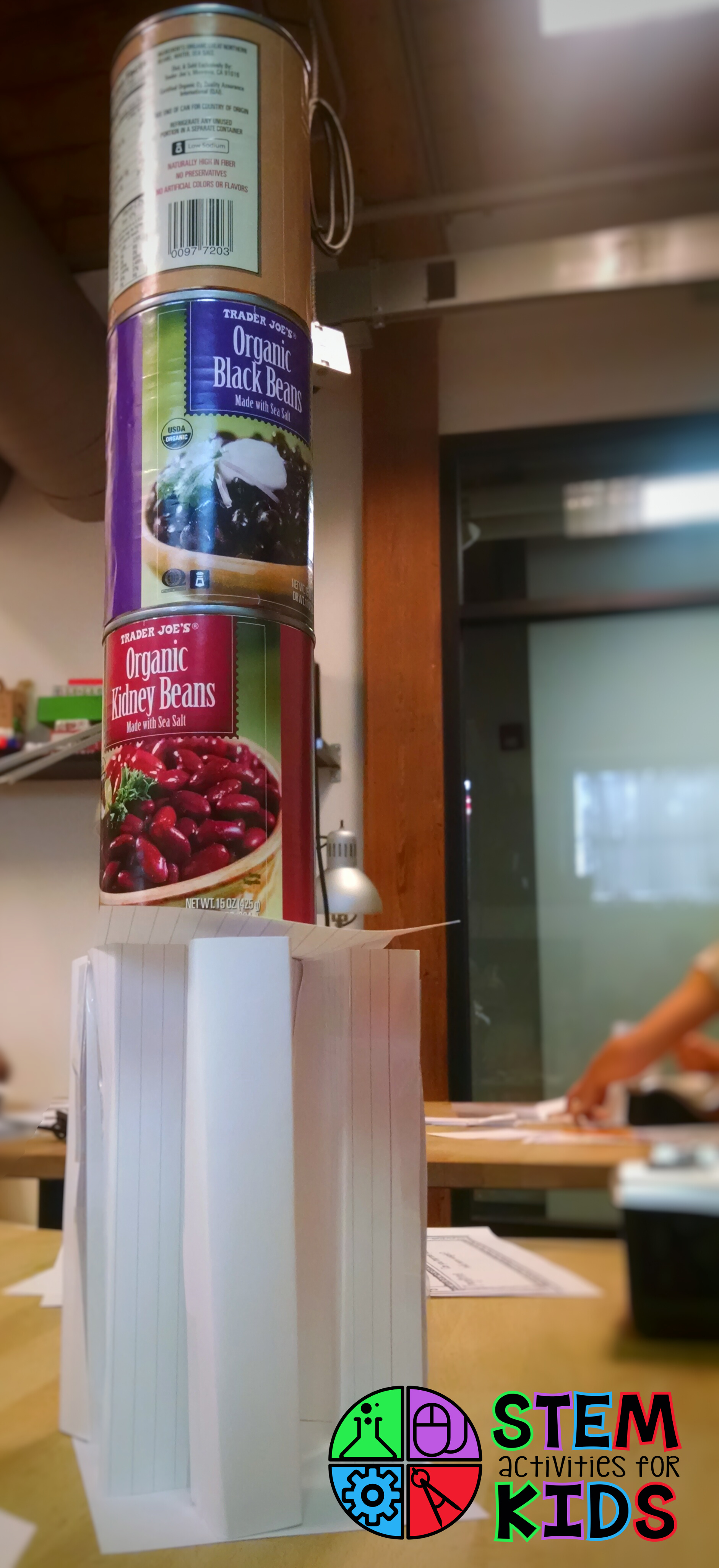
Last week in STEM class, we built towers with index cards. When I first showed the kids that we would be using just index cards and tape, I held up a floppy index card and a can of beans and asked them if they thought index cards were strong enough to hold the can. Most of them didn’t think it could be done! I asked them to think about ways they could change the shape of the card to make it stronger. They had a few ideas and then I showed them some ways to make different columns (circular, triangular, square), and how to make an accordion shape with the card. We got to work making our index card STEM towers:
Then they took time to plan out their designs. What I absolutely loved about this challenge is that every single index card tower was completely different! Working in groups of two, the kids built everything from short and wide towers, to very elaborate towers with multiple columns and walls.
When it was time to test the towers, they were a little apprehensive about the weight. After seeing that one can of beans was easily held, I told them they could try stacking two, and then three. They were so excited to see how much weight the towers held.
While they were working on building and testing, I had a surprise in the works: a “seat” made up of index card columns! I showed them the structure and asked if they thought index cards could support their weight. Pretty much everyone was in agreement that the cards would buckle under the load. One by one the students tried it out and it held up to all of them – to at least 80 pounds!
If you would like to use printables like the ones shown above (vocabulary cards, recording pages, etc.) you can find them in my Teachers pay Teachers shop here.
Or download the free graphic organizer:
Save
Want to try a guided index card tower challenge? This activity is included in the Engineering Design Process resource listed here:
Pin these ideas for later:
If you haven't spent much time scrolling social media lately, you might have missed the…
Bringing the Engineering Design Process into Your Classroom The engineering design process is one of…
You've (almost) made it! Testing season is (hopefully) behind you, and now it’s time to…
A hands-on engineering challenge that brings the classic fairy tale to life! This Three Little…
Create Stop Motion Animation Films with Students in 8 Simple Steps! Is the creativity and…
Black History Month is the perfect time to spotlight trailblazers who changed the world—and to…
This website uses cookies.
View Comments
I was wondering if the recording worksheets and lesson plans were available for this activity?
Hi Jamie,
Thanks for your question. I used the basic graphic organizer in my STEM Sampler (free): https://www.teacherspayteachers.com/Product/STEM-Sampler-Pack-2220744
I modified it for this challenge make it easier for the young class I was teaching so that they didn't have to write as much. You can use the organizer as is, or add these questions (by hand or digitally):
In the Ask section, I added "Can you design and build a tower that holds a heavy weight?"
In the Plan section, I added "My tower will use ____ index cards. It is _______ (inches, cm) tall."
In the Create section, I added the question "Did your tower hold the weight?"
In the Improve section, I added "Can you improve your tower to hold more weight?"
I hope that helps!
-Meredith
How many index cards do you give them?
Hi Pam. Anywhere from 10-25 index cards per team, depending on how long you have to spend on the tower construction.
Hey, this is awesome! How did you explain to your students the science behind it?
Hi Yessica,
This is a great, accessible explanation for students:
https://mass.pbslearningmedia.org/resource/phy03.sci.phys.mfe.zcolumnsi/columns-finding-the-strongest-shape/#.WTKaiPErIUQ
In exploring the shapes, it will be easier to see which shapes buckle more easily than others and why so many columns are circular. I also mention why this is the design you want for a column, but not a beam. A column takes an axial load, but a beam is subject to a bending moment (which is why you see I-beams). I hope that helps!
Another great structure in nature to look at is honeycombs! These maximize strength with minimal material.
Meredith
I absolutely love this activity! I am currently doing my student-teaching for my Bachelor's in Education, and would love to do this with my students. Do you happen to know which NGSS standard this activity aligns with?
Depending on what you include, several of the NGSS standards related to Matter and its Interactions, Motion & Stability: Forces and Motion, as well as Engineering Design.
How many index cards did you use for the chair that held 80 lbs.?
I can't recall! I want to say around 20.